A VC’s Career Advice Is Not Universal Career Advice

TLDR: A well-known venture capitalist recently told his large LinkedIn audience that founding a company carries "little career risk," that failure "generates optionality," and that joining a firm like Goldman Sachs is actually the riskier move. That may be true for him — a General Partner at a top-tier venture firm with capital, an elite network, and a soft landing built into his career by design. For most people, the math runs the other way. And even for those who share his starting position, the promise has a shelf life the post doesn't mention.
Tolerance for career risk is materially and socially structured, not just mindset.
A General Partner at a prominent Silicon Valley venture capital firm recently posted a piece of advice that spread widely:
"Founding a company might have job risk, but it often has little career risk. It's an example of an asymmetric bet. A bet that, if it works, will have tremendous upside, and if it doesn't, will still generate optionality. I think the ways we're taught to think about these concepts is backwards: we think something is risky (e.g. starting a company) when it actually buys optionality, and we think we're buying optionality (e.g. joining Goldman Sachs) when we're actually taking a big risk. In starting a company, we're capping our downside (assuming the privilege to afford it) and in joining Goldman Sachs etc, we're capping our upside."
He closes with a line that has the ring of inspiration: "Sometimes, however, you'll look dumb forever, so pursue something that, even if it bombs, the pursuit was its own reward."
It's a compelling argument. It is also a nearly perfect case study in how successful people mistake their own reflection for the world.
He's Not Wrong. He's Just Describing Himself.
I've written before about how tech CEOs—leaders known for their neurodivergence, humanities training, immigrant adaptability, or poker-honed risk tolerance—each look at the future of work and see, remarkably, the exact traits that made them personally successful. Each one is confident he's describing a general law of what will matter. Each one is actually describing himself.
This VC's post does the identical move, just with startup risk instead of AI's future. He is a General Partner at one of the most storied venture firms in the world. His daily environment is composed almost entirely of founders who raised capital, built networks, and—when things didn't work—landed on their feet, often inside his own fund's portfolio or orbit. That environment offers a highly selective view of entrepreneurship: founders who raised capital, built influential networks, and remained visible after setbacks. It’s also an unusually concentrated setting for survivorship bias, because the successful outcomes in that ecosystem directly validate the venture model in which he works.
I say “it depends” more than almost anything else in my work because context is the entire point. I’ve worked with nearly 3,000 people since 1997, most of them leaders and builders since 2012, and if there’s one throughline, it’s that everyone with a big platform has a narrow one. The managing partner of an Am Law 25 firm sees the world through that firm’s career ladder. The founder who exited two of three companies sees it through venture math. The person who built a product used by a billion people sees it through that scale. I have the same limitation—I generally work with leaders in tech, healthcare, finance, and law, not the retail manager at the local Home Depot, and I wouldn’t presume to tell that person what career risk looks like for them. The difference is I try to say so, instead of mistaking my sample size for the whole population.
This is availability heuristic and survivorship bias working together: we mistake a visible, successful subgroup for the whole population, because the failures never show up in the feed, the fund's returns deck, or the celebratory thread about a multibillion-dollar acquisition (Enago Academy, 2023; Decision Lab, 2021). The failures who didn't recover are, by definition, invisible to the person doing the generalizing.
What the Research Actually Shows About Who Can Afford This Bet
The post contains one honest parenthetical — "assuming the privilege to afford it" — and then argues straight past it, as if that clause were a footnote rather than the entire premise.
It is worth taking that clause seriously, because the research on it is not ambiguous. A large-scale study using household wealth data found that entrepreneurship builds wealth primarily for households that were already above the median wealth line before starting a business — for households below that line, starting a business showed no comparable wealth-building effect (Enterprise Research Centre, 2015). Put plainly: the "asymmetric upside" described in the post is not equally asymmetric for everyone who tries it.
A separate line of research digs even deeper into where the "privilege to afford it" actually comes from. Using Swedish population-level data, researchers found that extended family wealth — including resources held by parents, in-laws, and close relatives—strongly predicts who can enter capital-intensive industries and absorb the credit constraints that accompany starting a business (Karmaziene & colleagues, Swedish House of Finance, 2016).
This changes the meaning of the post's core sentence. When it claims starting a company "caps our downside," what it may actually be describing is a founder whose family, network, or personal capital caps the downside on his or her behalf. Entrepreneurial downside is often buffered by a describable, measurable form of privilege: access to family wealth, personal capital, and networks capable of absorbing a setback. And pretending otherwise is exactly the blind spot that makes advice like this land so differently depending on who is reading it.
Optionality Has a Shelf Life, Even for the Privileged
Here is the part the post misses entirely, even for the population it's speaking to. I've worked with founders who fit exactly the profile this post describes—capital, credentials, an elite network—and their trajectories often break in one of two ways. Some need their narrative branded once, and the market rewards it generously. Others try, and fail, and try again, several times in a row. Capital gets harder to raise with each unfunded swing. Their Ivy League pedigree stops functioning as a safety net and starts functioning as a countdown clock, because reputational capital in these circles depreciates the longer someone appears to be "still finding it." And critically, they’re not building the kind of evidence a traditional leadership role requires. They've never run the operating discipline of a CEO inside an accountable, large organization, so "regular" employers don't see them as credible leadership hires either.
The result is a specific, painful trap: VCs stop funding them because the base rate looks worse with each additional swing, and corporate employers won't hire them into senior leadership because their resume reads as "unproven founder," not "executive." Meanwhile, the classmates who took the traditional route now have fifteen or twenty years of exactly the operating credibility these serial founders can't manufacture retroactively. The post treats each attempt as an independently low-risk bet. It doesn't account for the fact that the market's patience for repeated, unmonetized attempts has a limit — and crossing it can leave someone with neither the founder upside nor the executive credibility, caught between two worlds that both reject them.
Optionality Has to Be Built
From the hiring side, the key question is how failure becomes optionality. It becomes career capital when it is translated into legible, provable evidence that a skeptical market will credit.
Research on entrepreneurial failure backs this up directly. A review of the literature on business failure found that failure experience does not, by itself, reliably improve a person's future venture performance—the benefit only materializes when the failure is processed through structured reflection and learning, not simply lived through (University of Central Lancashire research repository). Failure becomes instructive when it is metabolized into a story, a lesson, and a next move. That translation work takes time, self-awareness, and often coaching or mentorship that not everyone can readily access.
A related 2024 study on entrepreneurial intention found that perceived social safety nets—not raw risk tolerance—are what actually allow people to convert willingness to take risk into action, and to persist after a setback (PMC, 2024). This is the missing variable in the post entirely. The post describes risk-taking from a position where a safety net is already assumed. A safety net changes the mathematical and human meaning of risk. Without one, a startup bet can carry real and sometimes unrecoverable downside.
This is the exact argument I made in a previous piece about why the market doesn't pay people for vision alone. It pays for narrated, legible proof. A failed startup only becomes career capital if someone can tell that story in language a hiring committee or investor recognizes as credible. Even among people who look privileged from the outside, that translation labor, and the runway required to survive long enough to do it, isn’t evenly distributed.
Three Lenses, One Blind Spot
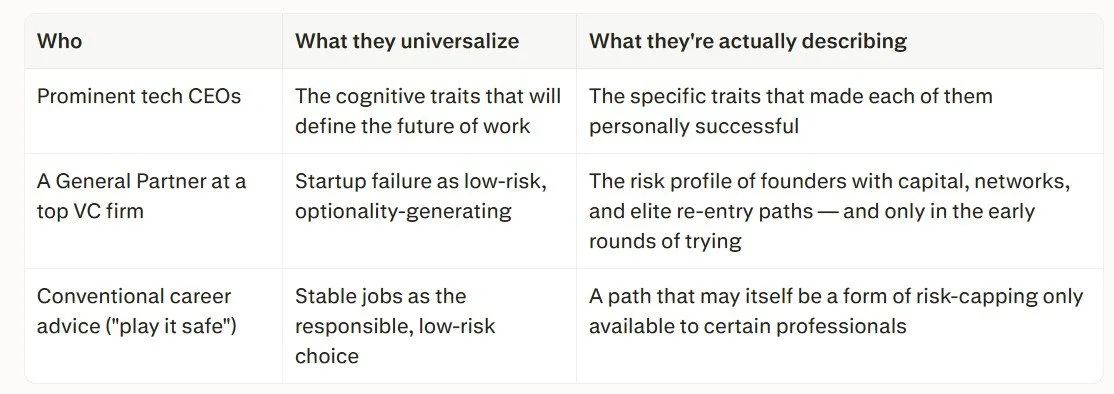
The venture capitalist's case is arguably the cleanest example of the three, because venture capital is a business model that benefits when more people believe risk is safer than it actually is. The more founders who believe failure is costless, the more shots on goal a fund gets to take. That doesn't make the advice cynical or dishonest — but it does mean the lens through which it's offered has a built-in incentive to stay exactly as blurry as it currently is.
Risk Tolerance Is Structured, Not Just Mindset. And It’s Time-Limited
The corrective here isn't "don't take risks." It's a more honest accounting of what risk-taking actually requires: income runway, family support, network access, professional re-entry options, and critically, a realistic sense of how many attempts the market will tolerate before "still building optionality" starts reading as "can't close." Some of that can be built deliberately, through what I've called a two-track career strategy: protecting income and credibility on one track while running deliberate, bounded experiments on the other. But the size of that second track (how much room someone has to fail safely, and how many times) is less about mindset. Instead, it’s materially and socially structured, and it degrades with repeated unmonetized attempts even for people who started with every advantage.
Whose Downside Is It, Really?
The original LinkedIn post's framing invites the reader to ask: "Am I bold enough to take the asymmetric bet?" That's the wrong question on two counts. It assumes the asymmetry is a personal trait rather than a structural condition, and it assumes the bet stays asymmetric no matter how many times you take it.
The better question is this: What would it actually cost you—not just once, but on the third or fourth attempt—and who is paying that cost while a well-capitalized general partner finds out, from a comfortable distance, that it worked out fine for him?
If you're weighing a leap—or wondering whether the leap you already took has left you stuck between two worlds—that's exactly the kind of inflection point I work through with clients, I’d be happy to chat. Schedule a conversation →
About Jared
Jared Redick is a San Francisco-based executive coach, communications strategist, and brand development consultant with more than 25 years of experience helping companies and high-level professionals position themselves for growth and change.
📚 Continue Reading: Executive Positioning & Search Strategy
Steve Jobs Wouldn't Have Hired Himself
Most of us grew up being told we could be anything if we just wanted it badly enough. It's a beautiful idea. It's also responsible for a lot of unnecessary suffering in executive careers.
The AI Predictions You’re Hearing May Say More About the Predictors Than the Future
You have more agency than you think.
FAQ
-
It depends heavily on who is asking. For someone with savings, family financial support, an elite professional network, and strong credentials to fall back on, a failed startup can genuinely function as a low-cost experiment. For someone without those buffers, the same failure can mean debt, damaged credit, lost health coverage, or years of lost income with no comparable safety net to fall back on.
-
Optionality refers to the future choices and opportunities a decision preserves or creates. Research on entrepreneurial failure shows optionality is not automatic — failure only becomes career capital when it is processed, reflected on, and narrated into a legible story that employers or investors recognize as credible experience, not simply survived.
-
This is a form of availability heuristic and survivorship bias: people surrounded primarily by others who succeeded through a particular path tend to overestimate how replicable and low-risk that path is, because the people who tried it and failed permanently are largely invisible to them.
-
Yes. Multiple studies, including research using Swedish population data, show that access to extended family wealth is one of the strongest predictors of who can enter capital-intensive industries and absorb the financial risk of starting a business, even when controlling for the entrepreneur's own personal savings.
-
Even well-credentialed, well-capitalized founders can run into a credibility gap after multiple unfunded attempts. Venture capital becomes harder to raise as the base rate on repeated tries looks worse, while traditional employers often see a serial founder without a large-scale operating track record as unproven for senior leadership roles, leaving some people caught between two worlds that both hesitate to hire them.
-
Rather than asking whether to take a big asymmetric bet, evaluate your own specific downside: your savings runway, family obligations, network strength, and ability to re-enter stable employment if the venture fails. A more resilient approach is often to run two tracks simultaneously — protecting income and credibility in a stable role while deliberately building evidence of ownership and initiative on the side.
Sources
Enterprise Research Centre. (2015). Does Entrepreneurship Make You Wealthy? https://www.enterpriseresearch.ac.uk/wp-content/uploads/2015/03/Does-Entrepreneurship-Make-You-Wealthy.pdf
Karmaziene, E., et al. (2016). Family Wealth and Entrepreneurship. Swedish House of Finance Research Paper. SSRN. https://papers.ssrn.com/sol3/Delivery.cfm/SSRN_ID2877662_code2215438.pdf
PMC. (2024). Effects of Failure Acceptance, Entrepreneurial Orientation, and Social Safety Nets on Entrepreneurial Intention. https://pmc.ncbi.nlm.nih.gov/articles/PMC11760853/
University of Central Lancashire Research Repository. Do Entrepreneurs Always Benefit from Business Failure Experience? https://knowledge.lancashire.ac.uk/id/eprint/28485/2/28485%20JBR%20Accepted%20-%20Final.pdf
Enago Academy. (2023). What Is Survivorship Bias? Definition, Impact & Examples. https://www.enago.com/academy/survivorship-bias/
The Decision Lab. (2021). Survivorship Bias. https://thedecisionlab.com/biases/survivorship-bias
Britannica. (2023). Survivorship Bias. https://www.britannica.com/science/survivorship-bias
Public LinkedIn post by a general partner at a venture capital firm, August 2026, quoted for commentary and critique.
Redick, J. Steve Jobs Wouldn't Have Hired Himself. The Redick Group. https://theredickgroup.com/blog/stop-trying-to-get-hired-to-be-steve-jobs
Redick, J. The AI Predictions You're Hearing May Say More About the Predictors Than the Future. The Redick Group. https://theredickgroup.com/blog/the-ai-predictions-youre-hearing-may-say-more-about-the-predictors-than-the-future