Think of Your Résumé as a Handshake, LinkedIn as a Broadcast

Your job search is private, but your LinkedIn profile is always on
The higher you ascend in rank and authority, the more what you share becomes a test of your professional judgment.
That principle has guided my work with senior executives for more than two decades, and in 2026, it’s still just as relevant. Sure, the tools have changed. AI-powered recruiter search, algorithmic profile ranking, and large language models now sit between you and the people trying to find you. But the core philosophy stands.
Your résumé is a handshake. Your LinkedIn profile is a broadcast. Confusing the two is both common and potentially costly for senior professionals.
The Handshake: Your Résumé
A handshake is private, intentional, and contextual. You extend it to a specific person, in a specific moment, for a specific purpose.
Your résumé works the same way. It’s a targeted document, written for a particular opportunity, shared in confidence with a particular reader, and calibrated to speak directly to a particular set of requirements. Every word is chosen and every detail is deliberate. What you include versus omit are strategic decisions.
This doesn't mean your résumé is confidential in a legal sense. But it is potentially sensitive. It may contain figures, organizational details, strategic context, or characterizations of past situations that you would share with a hiring authority across a conference table, but not broadcast to the world.
There are more readers on the other side of your job search than most leaders realize: in-house hiring committees, internal recruiters, external retained and contingency search firms, applicant tracking systems (ATS) from more than 100 developers worldwide—none of whom operate under a common standard, by the way—and the sprawling black hole of job boards that can scatter your materials in ways you may not have intended when you first submitted your materials.
Never post your résumé online without fully understanding the implications. The résumé we build together is engineered for private, intentional distribution. Not broadcast.
The Broadcast: Your LinkedIn Profile
LinkedIn was launched as an online résumé. It is not, however, a résumé, and in my view treating it as one is a strategic mistake.
Indeed, your LinkedIn profile is a broadcast. It’s visible to your next employer, your current employer, your clients, your competitors, your former colleagues, your board members, and every recruiter who has ever searched your name. It’s indexed by LinkedIn's own AI hiring tools, by Google, and increasingly by the large language models that power AI-assisted candidate sourcing.
That visibility is an asset if you use it thoughtfully. It’s a liability if you treat it as a place to copy-paste your résumé.
The goal of your LinkedIn profile isn’t to tell your whole story. It’s to tell enough of the right story that the people who matter want to ask for more—and to do so with language that’s accurate, appropriately calibrated for business in general, and optimized for how people search.
I position my clients' profiles as tools for business development first and career marketing second. Put another way, your LinkedIn profile can operate on two levels simultaneously: a "happy where I am" public face that colleagues, clients, and the world at large will accept at face value, and a carefully constructed, keyword-rich, search-optimized presence that passively attracts the right opportunities in broad daylight.
What's New in 2026: The AI Layer
When I first articulated this philosophy years ago, LinkedIn's search was basic and human-driven. That has changed fundamentally in 2026.
LinkedIn's AI Hiring Assistant and third-party AI sourcing tools now analyze your profile semantically. Not just for keyword matches, but for themes, patterns, and inferred competencies. That means:
Your headline is a signal, not a label. It’s the first element AI reads and one of the highest-weighted fields in search ranking, so structuring the headline is more consequential than it might seem.
Your Experience entries are structured data. AI tools parse job titles, dates, and achievement language as discrete data points. Titles, dates, and key metrics should be consistent between your résumé and LinkedIn.
Your Skills section is a map. LinkedIn's AI maps your listed skills directly to recruiter search filters. Astoundingly, LinkedIn allows 100 skills to be added to your LinkedIn profile, but they need to be current and relevant, and word on the street (although no formal proof) is that a skill carries more weight in the algorithm if it has at least one endorsement from someone else.
Your About section is read by machines before humans. Write it as a natural-language narrative, not a bulleted list of credentials. Use the words and phrases your target audience actually searches. It’s my understanding that AI systems today extract themes from prose more effectively than from lists.
The practical implication: everything on your LinkedIn profile is simultaneously a human-facing narrative and a machine-readable data set. It needs to work for both audiences at once.
The Judgment Standard Doesn't Change
None of this changes the fundamental principle. The higher your seniority, the more your profile is read as a reflection of both your credentials and your judgment.
That means:
Omit what doesn't belong in public. Revenue figures, organizational details, characterizations of past situations, and sensitive strategic context that serve a private hiring conversation do not automatically belong on LinkedIn.
Euphemize thoughtfully. There’s always a public-appropriate way to describe complex or sensitive career chapters—a turnaround, a leadership transition, a divestiture recommendation, a period of organizational difficulty. The résumé can be more specific. LinkedIn should be more measured.
Check your employer's policies. Many companies have explicit policies about what employees may and may not share on public platforms regarding financials, strategy, and organizational matters. When in doubt, err toward less.
Before You Edit: Turn Off Profile Sharing Notifications
Every edit you make to your LinkedIn profile can trigger a "Congratulate [Your Name] on their new job" or similar notification to your entire network.
If you want to suppress this behavior, turn it off before making changes to your profile:
Click the Me icon at the top right of your LinkedIn homepage
Select Settings & Privacy
Click Visibility in the left sidebar
Find Share job changes, education changes, and work anniversaries from profile
Toggle Share key profile updates to Off
While you’re in Settings & Privacy, give the whole thing a solid review to be sure you agree with your current settings.
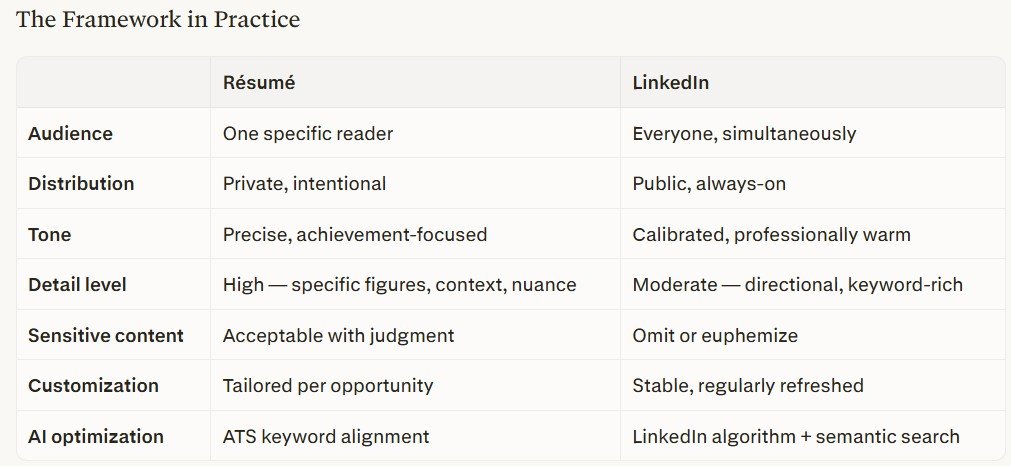
Private vs. Public: The Key Differences
The Bottom Line
Your résumé and your LinkedIn profile aren’t the same document in two formats. They’re two distinct tools serving two distinct purposes, and in my view, using one in place of the other, in either direction, is a mistake.
The résumé is your private argument. LinkedIn is your public presence.

About Jared
Jared Redick is a San Francisco-based executive coach, communications strategist, and brand development consultant with more than 25 years of experience helping companies and high-level professionals position themselves for growth and change. Get career coaching here, or co-develop your professional identity here.
FAQ
-
A résumé is a private, targeted document shared intentionally with specific hiring authorities. A LinkedIn profile is a public broadcast visible to everyone simultaneously — employers, colleagues, competitors, and AI-powered recruiter tools. Confusing the two is common, and for senior professionals, it can be costly. They serve different purposes and should be written and managed differently.
-
Key facts — job titles, dates, employers, and core achievements — should be consistent between the two. But LinkedIn entries can be less detailed and should omit sensitive figures, proprietary context, or language that is appropriate in a private hiring conversation but not for public broadcast. When in doubt, check your employer's policies on sharing financial or strategic information publicly, and err toward less.
-
Go to Settings & Privacy → Visibility → Share job changes, education changes, and work anniversaries from profile → toggle Share key profile updates to Off before making any edits. While you're in Settings & Privacy, review the rest of your settings to confirm they still reflect your preferences. Restore the setting when finished.
-
LinkedIn's AI Hiring Assistant and third-party AI sourcing tools now analyze profiles semantically — reading for themes, patterns, and inferred competencies rather than simple keyword matches. Your headline carries outsized weight because it's one of the first elements AI reads. Your Experience entries function as structured data, with titles and dates parsed as discrete fields. Your Skills section maps directly to recruiter search filters — LinkedIn allows up to 100 skills, and endorsed skills are believed to carry more algorithmic weight. Your About section is read by machines before humans, so natural-language prose outperforms bulleted credential lists.
-
Specific revenue figures that may be proprietary, characterizations of organizational difficulties or turnarounds that name individuals or internal situations, strategic details that may conflict with employer confidentiality policies, and any content that would be inappropriate if seen by a current employer, client, or board member. Where a chapter is genuinely sensitive, euphemize thoughtfully rather than omitting it entirely — there's almost always a public-appropriate way to describe a turnaround, leadership transition, or divestiture.
-
No. LinkedIn was launched as an online résumé but has evolved into something fundamentally different — a business development platform, professional network, and AI-indexed talent database. Treating it as an online résumé underutilizes its potential and can expose sensitive information to an unintended audience. Effective profiles operate on two levels at once: a "happy where I am" public face for colleagues and clients, and a keyword-rich, search-optimized presence that passively attracts the right opportunities.
-
Refresh your Skills section and About section at least annually. Update Experience entries when roles meaningfully evolve. Add Featured content, posts, or articles periodically to signal activity — LinkedIn's algorithm favors recently active profiles in search results. Before making any edits, turn off profile update notifications so changes don't broadcast to your entire network prematurely.
-
Item descriptionMore readers than most candidates realize: in-house hiring committees, internal recruiters, external retained and contingency search firms, applicant tracking systems from over 100 different developers with no shared standard, and job boards that can redistribute your materials beyond your original submission. Never post your résumé online without understanding these downstream implications.